
Why I Built a Reader That Responds to the Actor, Not Just the Cue
As an actor and filmmaker, I spend a lot of time thinking about what happens on both sides of the camera.
Filmmaking teaches you to control things. Frame the shot. Shape the light. Choose the lens. Cut at exactly the right moment.
Acting asks for something almost opposite.
Prepare everything you can, then allow yourself to be affected by what happens in front of you.
That tension became especially obvious to me as self-taping became a larger part of auditioning.
An audition arrives. You get the sides. Maybe it is late at night. Maybe you have a few hours. Maybe another actor is available tomorrow, but you want to start working tonight.
So you begin rehearsing alone.
And that is where I kept running into the same problem.
It was not simply that I needed somebody to say the other lines.
I needed something to respond to.
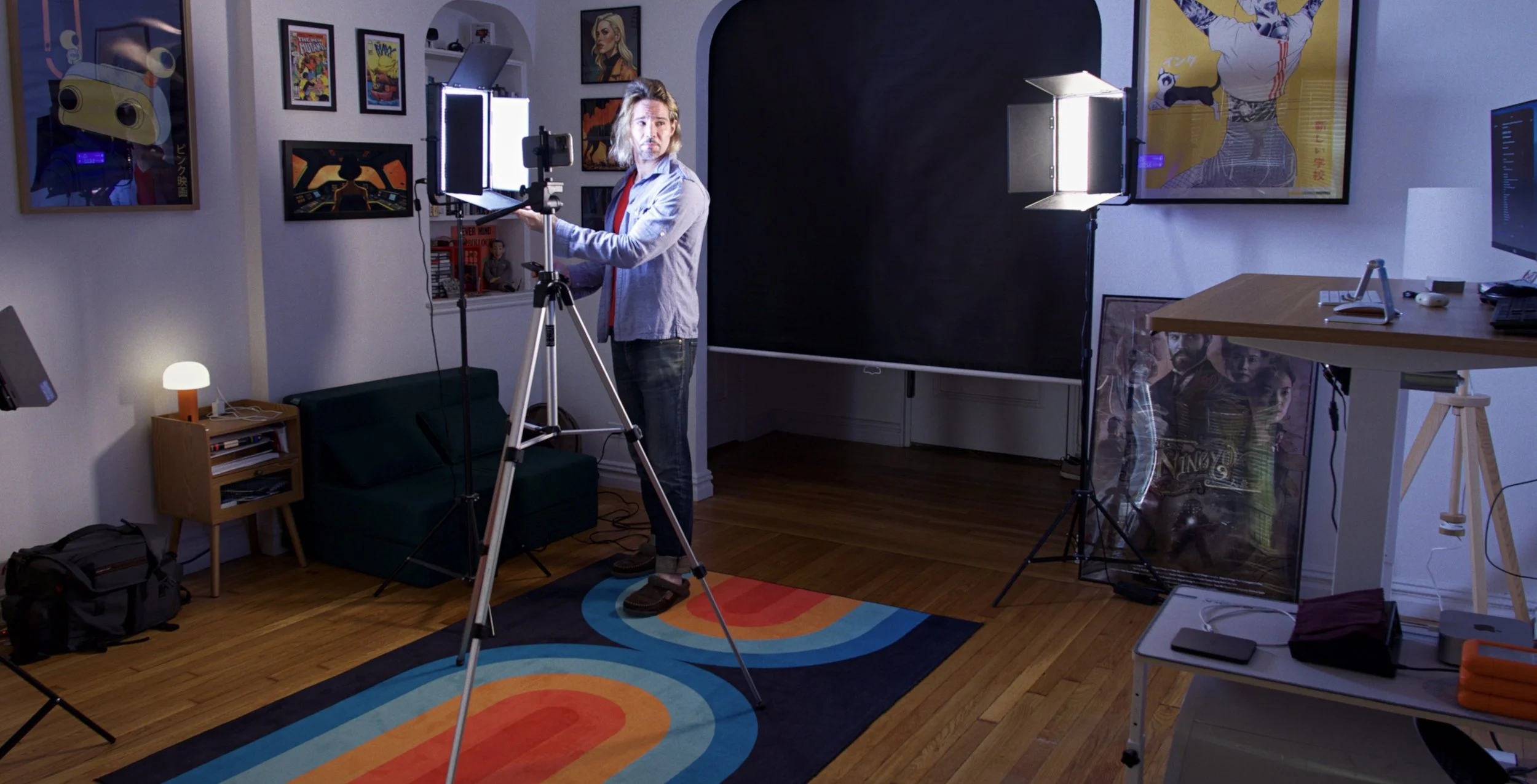
Rodrigo Lopresti in his self-tape setup, where acting, camera, lighting, sound, rehearsal, and Reader logistics all become part of the modern audition process.
Knowing When to Speak Is Only Part of the Problem
Actor rehearsal apps and self-tape Reader apps have become much better at solving one important problem: knowing when the Reader should say the next line.
That matters enormously.
A useful Reader cannot simply fire the next line because there has been a moment of silence. Actors pause. We breathe. We hesitate. We search. Sometimes the most important thing happening in a scene occurs between the words.
When I began building OffBook Studio, one of the first things I cared about was making rehearsal responsive to the actor's actual spoken cue rather than treating silence as permission to advance.
The app listens for the expected content of the actor's line and uses that information to decide when the scene should continue.
That helped solve the timing problem.
But after using the system over and over, another question began bothering me.
What if the Reader knew not only when to answer, but could respond to how I had just played the scene?
That became the more interesting problem.
The Difference Between Cue-Responsive and Performance-Responsive Rehearsal
A traditional prepared Reader performance can be incredibly useful.
In OffBook Studio's Classic Reader, an actor can choose a ready-made Reader voice or record the Reader performance themselves. If you want the other character to whisper, rush a line, challenge you, soften, hesitate, or come at you harder, you can build that performance intentionally.
That Reader performance then stays consistent.
For learning audition sides, running lines repeatedly, preparing a self-tape, or exploring a scene against something dependable, consistency is often exactly what you want.
There is real value in repetition.
But repetition creates a strange problem too.
Eventually, you know what is coming.
You know exactly how the other line will sound.
You know its rhythm.
You know its energy.
You know where the pause is.
And if you are not careful, rehearsal can slowly shift from responding to anticipating.
You begin performing the memory of the scene rather than encountering the scene again.
That is the point where I started thinking about a different kind of Reader.

OffBook Studio during a solo rehearsal and self-tape setup on iPhone.
What If the Reader's Performance Could Change Too?
That question eventually became Interactive LIVE Mode in OffBook Studio.
The idea is simple to describe even though the problem was not simple to build:
The Reader's dialogue stays locked to the script, but the performance of that dialogue can respond to the performance the actor just gave.
If the actor changes the energy, urgency, pace, tension, intimacy, or rhythm of the scene, the next Reader line can arrive differently too.
The words do not change.
The scene does not suddenly become improvisation.
The Reader does not rewrite the script.
Instead, the exact assigned Reader line is performed fresh in response to what just happened.
That distinction became the foundation of the system:
The word cue determines when.
The script determines what.
Interactive LIVE affects how.
For me, that is the difference between a Reader that merely follows the scene and one that can participate in the rhythm of it.
The Script Has to Stay the Script
Keeping Interactive LIVE script-locked was extremely important to me.
Actors preparing an audition are not usually looking for somebody to invent better dialogue.
We have sides.
Those words matter.
Casting expects those words.
The writer wrote those words.
So Interactive LIVE is not designed to improvise another character's dialogue, add commentary, invent story beats, or decide what should happen next.
The Reader's line remains the Reader's line.
What changes is the relationship to it.
If I play the preceding moment differently, I want the possibility that what comes back to me feels different too.
The script stays the same. The relationship to it doesn't.
That was the thing I had been missing when rehearsing scenes alone.

Interactive LIVE Mode in OffBook Studio. The script stays locked while the Reader’s performance responds to how the actor just played the scene.
Why This Matters to Me as an Actor
There is a profound difference between memorizing lines and rehearsing a scene.
You can learn dialogue by yourself.
You can repeat it until the words are completely automatic.
That is useful work.
But acting does not happen entirely inside one person.
A scene is an exchange.
Something reaches you, affects you, and changes what you do next.
Even in a self-tape, where another actor may be standing off camera reading from a laptop, that relationship still matters.
The Reader's timing matters.
Their rhythm matters.
Whether they are listening matters.
What they give you can change what becomes available in your own performance.
When another actor is available, there is no technology I would choose instead of actually working with them.
But another actor is not always available for the hours of rehearsal that happen before the tape.
That reality is what OffBook Studio was built around.
The Meisner Connection
I trained as an actor in the Meisner tradition, and one idea from that work has stayed with me throughout my career: your attention belongs on what you are receiving, not on manufacturing a result inside yourself.
Interactive LIVE was designed around an acting principle central to Meisner training: what you receive from your partner should affect what happens next.
That does not make OffBook Studio a Meisner training system.
It is not.
And Interactive LIVE is not a substitute for working with another actor.
But the acting principle matters to the design.
If rehearsal becomes completely predictable, it becomes very easy to stop receiving.
You begin waiting for the thing you already know is coming.
I wanted to see whether technology could preserve a little more uncertainty inside solo rehearsal.
Not chaos.
Not improvisation.
Just enough responsiveness that the actor still has something to encounter.
Classic Reader and Interactive LIVE Solve Different Problems
I do not think of Interactive LIVE as replacing the Classic Reader.
They are useful for different reasons.
Classic Reader is faster, repeatable, and predictable in the best sense of the word.
If I am learning a scene, testing choices, preparing audition sides, or trying to get repetitions under my belt, consistency is incredibly useful.
Interactive LIVE is intentionally less fixed.
It generates a fresh performance of the next assigned Reader line after responding to how the actor just played the preceding moment.
That makes it better suited to exploration and spontaneity.
One gives you a Reader performance you control.
The other gives you a Reader performance that responds.
There are days when I want one and days when I want the other.
Self-Taping Changed More Than the Camera
One reason I built OffBook Studio is that self-taping quietly transferred an enormous amount of the audition process onto actors.
We became responsible for the camera.
The lighting.
The sound.
The framing.
The Reader.
The rehearsal.
The edit.
The upload.
And somewhere underneath all of that machinery, we are still supposed to act.
Technology for actors interests me most when it removes some of that machinery from our attention.
Not when it becomes the center of the experience.
That is why I have never been particularly interested in building technology simply because the technology itself is impressive.
The question I keep coming back to is much simpler:
Does this give the actor more room to act?
If it does not, I am not sure it is solving the right problem.
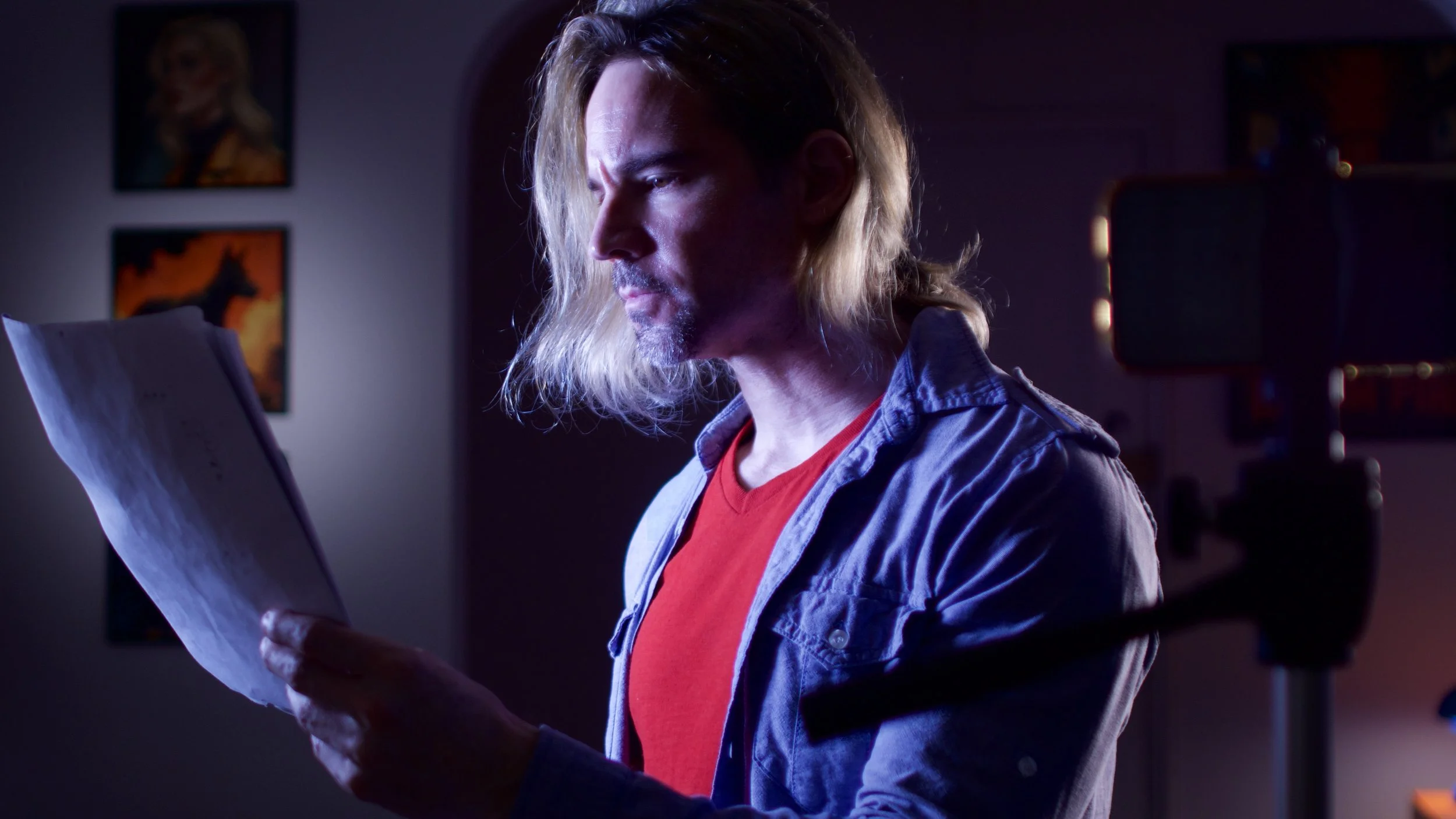
Rodrigo Lopresti working through audition sides alone. The point of rehearsal technology is not to replace another actor, but to give the performer something useful to work against when nobody else is available.
Built for the Hours When Nobody Else Is There
A great scene partner is irreplaceable.
A generous Reader can change an audition.
A coach can open a scene in ways software never will.
Interactive LIVE was not built to argue otherwise.
It was built for the other hours.
The hour when the sides arrive late.
The afternoon when you want to run the scene twenty times.
The night before the tape when nobody is free.
The stretch of rehearsal before you are ready to ask another person to give you their time.
Those hours are increasingly part of being an actor.
And I wanted something in those hours that did more than wait for me to finish speaking.
I wanted something that could listen to the performance and let the next moment come back a little differently.
That became OffBook Studio.
And eventually, it became Interactive LIVE.
Because knowing the cue was only the beginning.
The more interesting question was always:
What happens next because of what the actor just gave you?
Rodrigo Lopresti is a New York actor, filmmaker, and founder of OffBook Studio, an iPhone rehearsal and self-tape app built for actors.